


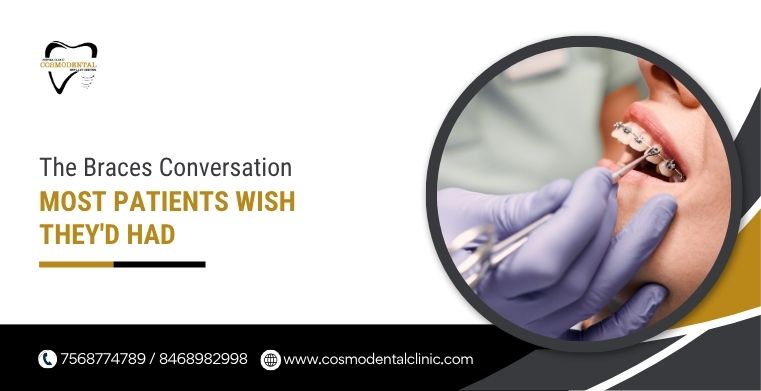
Almost every patient who comes to us for braces treatment in Wanowrie at Cosmodental Clinic says some version of the same thing after their first proper consultation: "I wish someone had explained this to me earlier." Not because the treatment is complicated, but because most people spend months or years sitting on the idea, forming assumptions from what they've seen on others, and talking themselves out of it before they've even had a real conversation with someone who actually knows.
This is that conversation. The one that covers what braces treatment genuinely involves, what the experience looks like day to day, what the options are, and what patients should realistically expect from the process and the outcome.
Before any treatment is recommended, we need to understand what's actually happening with the teeth, the bite, and the jaw. This is a step that cannot be skipped or guessed at, and it's the reason we never give timeline or cost estimates before seeing a patient properly.
The assessment at Cosmodental Clinic typically involves:
What comes out of this appointment is a treatment plan that reflects that specific patient's teeth, not a generic protocol. Two patients with similar-looking crowding can have very different underlying situations, and the treatment plan needs to account for that.
This is where most patients have the most questions, and understandably so. The options available now are genuinely different from what braces treatment looked like ten or fifteen years ago.
Metal braces are the most established option. They use stainless steel brackets bonded to the front of each tooth, connected by an archwire that applies consistent pressure to move teeth gradually. They're highly effective across a wide range of cases, including complex bite corrections and significant crowding. They're also the most affordable option in most treatment plans.
Ceramic braces work the same way as metal braces mechanically, but the brackets are tooth-coloured, making them far less visible. They suit patients who want the reliability of fixed braces without the visual prominence of metal.
Clear aligners, including invisible braces treatment in Wanowrie, use a series of removable transparent trays to shift teeth gradually. They work well for mild to moderate alignment concerns and are particularly popular among adults and working professionals who prefer a discreet option. They require a high level of consistency, as the trays need to be worn 20-22 hours a day for treatment to progress on schedule.
Which option suits a patient depends on the complexity of their case, their lifestyle, and their priorities. We go through this thoroughly during the consultation so the decision feels informed rather than pressured.
Braces treatment runs anywhere from 12 months to about 30 months, depending on the complexity of the case. That's a range, not a guarantee, and we're upfront about that from the start.
During treatment, patients come in for adjustment appointments every four to six weeks. These visits are shorter than the initial assessment, usually around twenty to thirty minutes. We check progress, make adjustments to the wire or move to the next aligner tray, and address anything the patient has noticed between visits.
The physical experience of braces varies across the treatment period:
Eating habits change during treatment. Hard, sticky, and chewy foods need to be avoided with fixed braces because they can dislodge brackets or bend wires. This is a real adjustment for some patients, and it's worth being honest about rather than mentioning as an afterthought.
Keeping teeth clean with braces on is more involved than regular brushing, and patients who don't adjust their routine during treatment can end up with staining or early decay around the brackets by the time they're removed.
What good oral hygiene during braces looks like:
We spend time on this at the start of treatment and check in on it during adjustment visits. It's not an area we gloss over because the outcome at the end of treatment depends as much on how well teeth were maintained during it as on the mechanics of the braces themselves.
This is the part of braces treatment that catches many patients off guard. When the braces come off, the teeth are in their new positions, but the bone and ligaments around them haven't fully stabilised yet. Without a retainer, teeth will shift back. This is not a complication or an exception. It's the normal biology of orthodontic treatment.
Retainers come in two forms:
Most patients at our clinic end up with a combination of both. We explain the retention plan before treatment ends so there are no surprises, and we review it at the final appointment.
Patients looking for braces treatment in Wanowrie come to us for different reasons. Some have been referred. Some found us while searching for the best dentist in Fatima Nagar, Wanowrie. Some came in for something unrelated and ended up in a conversation about their teeth that led here.
What they consistently tell us afterward is that they felt properly informed throughout. That the process matched what they were told to expect. That they didn't feel rushed into a decision or handed a package before they were ready.
That's what we aim for with every patient who walks in asking about their teeth.
The patients who wait the longest to start braces treatment in Wanowrie are rarely the ones with the most complex cases. They're usually the ones who had questions they didn't know where to take.
At Cosmodental Clinic, the first consultation is where those questions belong. Come in, ask everything, and leave with a clear picture of what treatment would actually look like for your teeth specifically. That clarity is what turns "I've been meaning to sort this out" into something that actually gets sorted.